


Australian Lower House Passes Gambling Advertising Reforms Following Bipartisan Agreement



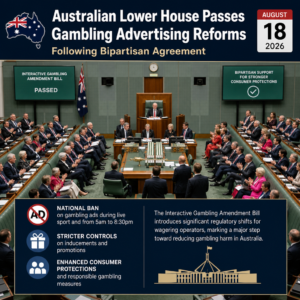 On August 18, 2026, the Australian House of Representatives passed comprehensive legislation aimed at reforming gambling advertising and consumer inducements. The passage of the Interactive Gambling Amendment Bill follows a negotiated agreement between the governing Labor Party and the opposition Coalition. The legislation introduces significant regulatory shifts for wagering operators, including a national opt-out advertising register and stringent restrictions on promotional inducements. The bill will now proceed to the Senate for final approval.
Key Regulatory Measures
The legislative package mandates several new operational compliance requirements for the gambling industry. The primary components of the reform include:
-
National Opt-Out Register: The Australian Communications and Media Authority (ACMA) will oversee a centralized system allowing consumers to opt out of receiving wagering advertisements across all online content platforms. Licensed operators will fund this initiative through an industry levy.
-
Inducement Restrictions: Wagering companies are prohibited from directing marketing materials to new customers within the first 14 days of account creation. This prohibition extends to 90 days for individuals who deregister from BetStop, Australia’s national self-exclusion register, and applies indefinitely to customers identified as high-risk.
-
Commission Bans: The legislation prohibits performance-linked commission arrangements for account managers and affiliates that incentivize customer acquisition or retention.
-
Broadcast Limitations: Broadcasters are restricted to a maximum of three gambling advertisements per hour between 5:00 a.m. and 8:30 p.m. Additionally, the advertising blackout period prior to live sporting events has been extended from five to 15 minutes, and the use of professional athletes or celebrities in advertising is prohibited.
Industry and Legislative Context
The reforms follow a 2023 parliamentary inquiry into online gambling, which initially recommended a phased, comprehensive ban on all online gambling advertising over a three-year period. The current legislation represents a regulatory compromise, balancing consumer protection with industry operations. Prime Minister Anthony Albanese characterized the legislation as a necessary measure, stating the government aimed to ensure “that we get the balance right between people who want to go along and have a punt on a Saturday at the races, but also, that problem gambling is actually dealt with.”
Stakeholder Perspectives
The bipartisan agreement secured the bill’s passage through the lower house, though it faced opposition from multiple political factions. Members of the Greens party, several independent lawmakers, and two Coalition members opposed the legislation, arguing that the measures remained insufficient without a complete advertising ban.
Conversely, industry representatives have expressed operational concerns regarding the implementation timeline. Kai Cantwell, Chief Executive Officer of Responsible Wagering Australia (RWA), noted the expedited nature of the new mandates. “This new global opt-out system, akin to BetStop, is proposed to be designed, developed and implemented in less than four months,” Cantwell stated. “Betstop, which is a simpler concept, took more than four years from inception to implementation.”