



Texas Senators Weigh Options on Prediction Markets Ahead of 2027 Gambling Debate



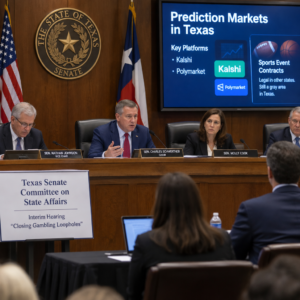 The Texas Senate Committee on State Affairs heard testimony on September 15 regarding the rapid growth of online prediction markets, as lawmakers consider how – or whether – the state can restrict platforms such as Kalshi and Polymarket that offer sports event contracts in Texas despite the state’s prohibition on gambling. The interim hearing, held under the charge of closing “gambling loopholes,” comes ahead of the January 2027 legislative session, when lawmakers are expected to revisit the broader question of gambling expansion.
A Jurisdictional Conflict Frames the Hearing
Testimony centered on a fundamental question: are prediction markets regulated derivatives exchanges, or sports wagering by another name? Operators such as Kalshi register with the Commodity Futures Trading Commission (CFTC) as designated contract markets and argue that federal law preempts state gambling regulation. Critics, including state officials and gaming industry representatives, contend the platforms are effectively operating sportsbooks outside the licensing, tax, and consumer-protection frameworks that govern legal wagering in other states.
The dispute has escalated nationally. The CFTC has filed lawsuits against multiple states that attempted to regulate prediction market operators under their gambling laws, asserting exclusive federal jurisdiction over the platforms. In July, attorneys general from 44 states signed a letter arguing the commission has no authority over sports event contracts. Meanwhile, state litigation continues: Michigan’s attorney general secured an injunction against Kalshi, and New Jersey has asked the U.S. Supreme Court to resolve the question. Conflicting appellate rulings have created a circuit split, and observers expect the high court may take up the jurisdictional issue as soon as 2027.
Options Under Consideration in Texas
Recommendations presented to the committee reportedly included litigation against prediction market operators, legislative restrictions, and consumer-safeguard measures. Witnesses also examined the range of contracts offered on the platforms, which extend beyond sports to elections, economic indicators, weather, and geopolitical events – raising additional concerns among lawmakers about the integrity of Texas elections.
The hearing reflects a directive from Lt. Gov. Dan Patrick, who in March charged senators with studying ways to close loopholes allowing prediction markets to operate in the state. The committee is expected to issue a report that will help shape legislation in the 2027 session, when proposals to legalize sports betting are also likely to resurface.
Political and Commercial Considerations
The issue carries financial and political dimensions. According to reporting by The Dallas Morning News, Kalshi and Polymarket together donated $57,500 exclusively to the Texas Senate Republican caucus while the examination was underway. On the opposing side, the American Gaming Association has urged Texas to require prediction markets to comply with state gambling laws, aligning with commercial operators who would face state licensing if wagering were legalized.