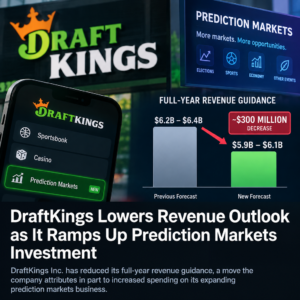
 DraftKings Inc. has reduced its full-year revenue guidance, a move the company attributes in part to increased spending on its expanding prediction markets business. The sports betting operator now expects fiscal-year revenue of $5.9 billion to $6.1 billion, down approximately $300 million from its previous forecast of $6.2 billion to $6.4 billion.
The revised outlook accompanied third-quarter results that fell short of analyst projections on both revenue and user growth. While the company continues to see activity in its core sportsbook and iGaming operations, management signaled that marketing and infrastructure investments tied to its new prediction markets platform will weigh on near-term financial performance.
DraftKings has positioned prediction markets as a significant growth avenue. The company’s Predictions platform, operated through a CFTC-registered entity, allows customers to trade event contracts on sports, political, and other outcomes for a nominal transaction fee. Chief Executive Officer Jason Robins has described prediction markets as a substantial opportunity, noting that the company launched the offering after acquiring an exchange licensed by a federal regulatory agency.
Competitive and Margin Pressures
The strategic shift comes as federally regulated prediction market platforms, including Kalshi and Polymarket, expand rapidly in the real-money forecasting space, introducing new competition for traditional sportsbooks. Robinhood has also moved aggressively into the category, intensifying pressure on established operators.
Robins has maintained that prediction markets are not cannibalizing DraftKings’ core sports betting business, and the company has stated in earnings materials that it is not observing an adverse impact from prediction market competition on existing operations. Nonetheless, the pulled-forward marketing spend has compressed margins in the near term, a dynamic that has weighed on the stock.
Balancing Short-Term Costs Against Long-Term Growth
The company’s decision reflects a broader tension facing the gaming industry: whether to invest heavily now to secure a position in an emerging, fast-growing market, or to protect near-term profitability. Analysts have offered varied estimates for the potential size of DraftKings’ prediction markets business, with some projecting hundreds of millions of dollars in annual revenue potential as the category matures.
Supporters of the strategy point to DraftKings’ existing customer base, brand recognition, and regulatory expertise as advantages over newer entrants. Skeptics note that the company faces execution risk, regulatory uncertainty in some jurisdictions, and rivals with established liquidity in event contract trading.