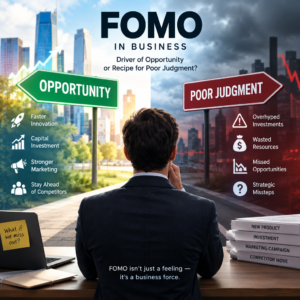
 The fear of missing out – commonly known as FOMO – has become an increasingly visible force in corporate strategy, marketing, and investment decisions. Once studied primarily as a social phenomenon, FOMO now shapes how companies allocate capital, launch products, and respond to competitors. Whether it serves as a useful catalyst for action or a source of costly misjudgment remains a matter of ongoing debate among researchers and industry practitioners.
What FOMO Looks Like in a Business Context
In commercial settings, FOMO describes the anxiety that arises when decision-makers believe competitors are capturing opportunities – new technologies, emerging markets, or shifting consumer trends – before they do. This dynamic manifests in several areas:
-
Strategic decisions: Executives may pursue acquisitions, digital transformations, or market entries primarily because peers are doing so, rather than because the moves align with long-term objectives.
-
Investment behavior: Research on retail investors has linked FOMO to overtrading and herd behavior, particularly during periods of market hype. Regulatory bodies, including the UK’s Financial Conduct Authority, have published guidance aimed at helping investors recognize and manage the effect.
-
Marketing practice: Businesses frequently deploy FOMO deliberately, using scarcity messaging, limited-time offers, and social proof to accelerate consumer purchasing decisions.
The Case for FOMO as a Productive Force
Proponents argue that a measured awareness of missed opportunity can function as a healthy competitive signal. Awareness that rivals are moving quickly can prompt organizations to re-examine slow internal processes, question complacency, and act on genuine opportunities before windows close.
When grounded in real value, FOMO-driven tactics can also support legitimate business goals. Limited availability tied to genuine capacity constraints, for example, communicates scarcity that is factual rather than manufactured. Some analysts note that FOMO-based appeals can be constructive when they support real value, community, and trust, rather than artificial pressure.
The Case Against
The risks, however, are well documented. Studies published in academic journals have found that FOMO-oriented marketing practices can cause emotional, financial, and behavioral distress among consumers, potentially damaging long-term brand relationships and subjective well-being. Impulse purchases triggered by urgency cues frequently lead to dissatisfaction and returns, eroding the trust that sustains customer loyalty.
At the organizational level, the consequences can be more severe. Decisions made under competitive anxiety often suffer from inadequate due diligence. In financial markets, commentators have observed that FOMO can fuel speculative surges and contribute to volatile market cycles, with inflows arriving late in a trend when downside risk is greatest. For leadership teams, chasing every emerging trend – whether a technology, a platform, or a business model – can dilute strategic focus and stretch resources across initiatives that lack a clear connection to core capabilities.
Finding the Balance
The available evidence suggests that FOMO is neither inherently beneficial nor harmful; its effect depends on how it is managed. Analysts commonly recommend a set of safeguards:
-
Anchor decisions in strategy. An opportunity should be evaluated against long-term objectives, not against competitors’ actions alone.
-
Verify scarcity claims. Marketing urgency should reflect genuine constraints to avoid regulatory and reputational exposure.
-
Separate signal from hype. Monitoring competitors is prudent; imitating them reflexively is not.
-
Apply standard diligence under time pressure. Deadlines imposed by external events warrant the same analytical rigor as routine decisions.
FOMO is an inescapable feature of competitive markets, and its presence in boardrooms and marketing departments is unlikely to diminish. Treated as a prompt for disciplined evaluation, it can alert organizations to genuine shifts and sharpen responsiveness. Allowed to operate unmanaged, it encourages imitation over analysis and short-term reaction over durable strategy. For industry professionals, the practical question is not whether FOMO exists, but whether decision-making processes are robust enough to keep it in check.