


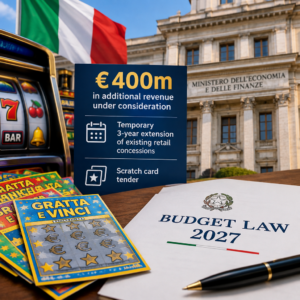
 Italy’s government is examining a series of measures to extract additional revenue from the gambling sector as it prepares the 2027 Budget Law, according to reports emerging from the Ministry of Economy and Finance (MEF). With an estimated €400m in contributions under consideration, the bulk of the sum would reportedly come from a temporary three-year extension of existing retail concessions, complemented by a new tender for scratch card licences.
Land-Based Reform on Hold
The deliberations come after the reorganisation of Italy’s land-based gambling framework – including betting shops, gaming halls and gaming machines – was abandoned in August. That reform, which had been intended to modernise the retail sector’s licensing structure, was shelved amid broader political and fiscal pressures, leaving the sector’s current concession regime in place.
The Ministry of Economy and Finance is now assessing whether a three-year extension of the existing retail concessions can serve as an interim revenue measure. According to industry reporting, such an extension alone could generate up to €500m, although official figures have not been confirmed. The extension would defer a competitive re-tendering of the retail market, giving incumbent operators additional certainty while the government completes a more comprehensive reform.
Scratch Card Tender Under Review
Alongside the retail concession extension, a €1bn tender for scratch card licences is reportedly among the options under review. The instant lottery segment has historically been one of the most stable revenue contributors in the Italian market, and a competitive tender could provide a one-off injection of licence fees into state coffers.
The renewed focus on gambling revenue also reflects the lapse of the mandate attached to Italy’s Tax Delegation Law, which had provided the legislative basis for broader restructuring of the sector’s fiscal and regulatory framework. With that mandate expired, the government is effectively limited to more incremental, budget-driven measures in the short term.
Balancing Revenue Needs and Market Stability
For licensed operators, the proposals present a mixed picture. An extension of current concessions would provide operational continuity for holders of betting, gaming hall and machine licences, many of which have been operating under the expectation of an imminent re-tender. At the same time, the removal of a firm timeline for reform prolongs uncertainty regarding the long-term structure of the retail market.
Policymakers face the challenge of positioning Italian gambling as an efficient and reliable source of tax revenue without undermining channelisation – the principle of directing players towards regulated operators. Excessive short-term fiscal extraction, industry stakeholders have historically argued, risks eroding the licensed sector’s competitiveness against unregulated alternatives.