



Genting Coventry Closure Underlines Industry Concerns Over Machine Games Duty
 Genting Casinos UK has confirmed the closure of its venue at the Coventry Skydome, a decision that arrives against the backdrop of growing pressure on the land-based casino sector from potential increases in Machine Games Duty (MGD). The move has been widely interpreted within the industry as a practical illustration of the financial vulnerabilities operators have repeatedly raised with the Treasury.
Closure Follows Formal Consultation
Staff at the Coventry Skydome venue entered a 30-day consultation process that began on 1 September, with the company stating at the time that the future of the city-centre site was under review. The venue has since ceased trading, and Genting’s own website now directs former Coventry customers to alternative Midlands locations, including Resorts World Casino at the National Exhibition Centre and Genting Casino Leicester.
The closure affects a venue that had formed part of Genting’s UK estate of 32 casinos, one of the largest land-based portfolios in the country. The company has not publicly attributed the Coventry decision to any single cause, and the consultation process was described by the operator as a standard review of site viability.
MGD Proposals Cast a Shadow Over the Sector
The timing of the closure has nonetheless drawn attention to the industry’s ongoing dispute with government over Machine Games Duty, which is currently levied at 20% on casino and gaming machine gross gaming yield. Proposals to double the rate to 40% have been under discussion, and industry figures have warned of substantial consequences should such a change be implemented.
Paul Willcock, Chief Executive of Genting Casinos UK, has previously stated that doubling MGD from 20% to 40% would add approximately £16 million per year to the company’s costs. He has also indicated that around 13 of the group’s 32 British casinos – roughly 38% of the estate – would become unprofitable under such a scenario, placing an estimated 850 jobs at risk across the business.
Industry bodies have reinforced these warnings at a sector-wide level. The Betting and Gaming Council’s casino group has cautioned that even a more modest rise in MGD to 25% could result in the closure of up to 40 casinos and the loss of up to 3,500 jobs, equivalent to approximately one third of the sector’s workforce. The Council has argued that any such increase would undo recent gains in employment and investment across the land-based industry.
It should be noted that the Autumn Budget 2025 confirmed no change to the rate of Machine Games Duty, with the most significant tax increases falling on the remote sector, including a rise in Remote Gaming Duty from 21% to 40% effective from April 2026. However, debate over the future treatment of gaming machine duty has continued, and operators remain exposed to any future policy shift.
For its part, the government has defended the broader modernisation of gambling taxation on the grounds of revenue generation and regulatory coherence. Estimates cited during the policy debate suggested that modernisation measures could increase gross gaming yield within the sector by £53 million to £58 million, figures that have been used to argue that the industry retains capacity to absorb adjusted fiscal arrangements.
The industry’s counter-position rests on the structural differences between land-based and remote operations. Casino venues carry fixed overheads in staffing, premises, and compliance, and operators argue that machine revenue provides a narrow margin of profitability that higher duty rates would eliminate. The closure in Coventry, whatever its specific local drivers, offers a case study that both sides of the debate are likely to reference.
Entain Raises Concerns with SIS Over Commercial Deal with Black-Market Operator
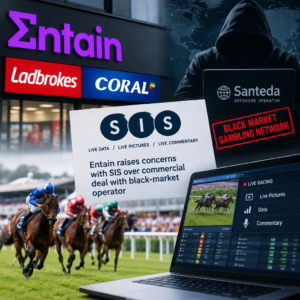 According to a report in the Racing Post, Entain, the owner of Ladbrokes and Coral, has raised concerns with racing data and live-feed supplier SIS following reports that the company entered into a commercial arrangement with Santeda, an offshore operator widely identified as one of the largest black-market gambling networks targeting British consumers.
SIS, which supplies live pictures, data and commentary to the betting industry in the UK and Ireland, is majority owned by bookmakers and counts Entain among its shareholders, with a stake of approximately 23.4 per cent. Reports indicate that SIS struck a business-to-business deal with Santeda in 2022, which may have remained in place until recently.
Entain has stated that it was not a party to the agreement, saying it was “not a party to the commercial or customer arrangements SIS decides to strike.” The company added that once the relationship came to light, it raised the matter directly with SIS.
Who Is Santeda?
Santeda International BV, a Curaçao-based operator, has been the subject of investigations linking it to a network of unlicensed casino and betting platforms serving UK customers. Research by the analytics firm GAMRS estimated that Santeda-affiliated sites generate turnover of approximately £3.5 billion per year, with around £2 billion deposited annually by British consumers. These figures underline the scale of the unregulated market that licensed operators, including Entain, have repeatedly warned about.
The reports of the SIS deal emerged alongside wider media investigations into offshore gambling networks and the payment channels that support them, placing the arrangement under renewed scrutiny.
Tension Within the Industry
The situation presents a notable point of tension for the racing and betting sectors. Entain has positioned itself as a leading campaigner against the black market, calling for measures including payment blocking, advertising restrictions and greater cooperation between regulators, sports bodies and technology firms. The revelation that a supplier in which it holds a significant stake may have contracted with an unlicensed operator sits uneasily with that stance.
For SIS, the episode raises questions about commercial governance and due diligence, particularly given its ownership structure. The company’s shareholders include several major licensed bookmakers whose commercial interests depend on directing customers to regulated channels. Revenue flowing from licensed operators also underpins the funding model of British racing, which receives contributions tied to betting activity through regulated channels.
At the same time, industry observers note that suppliers operate in a competitive market and that shareholder companies do not typically dictate individual commercial agreements. SIS has not been reported to have issued a detailed public response addressing the concerns raised.
CreedRoomz Brings Its Live Casino to Switzerland
 Groupe Partouche’s Casino du Lac Meyrin, in Geneva, has signed a strategic partnership with CreedRoomz, the live casino brand of the SoftConstruct group, to bring its live dealer games to PASINO.ch, the casino’s licensed online platform. The agreement was formalised at SBC Summit Lisbon 2026, with the first CreedRoomz tables expected to go live on PASINO.ch in Q1 2027, subject to the approval of the Swiss Federal Gaming Board (ESBK/CFMJ).
The partnership further strengthens PASINO.ch’s games ecosystem and reflects Groupe Partouche’s continued ambition to work with partners who bring real value to the Swiss market. Through CreedRoomz, Swiss players will gain access to a selection of live tables, including blackjack, roulette, baccarat and game shows, streamed from CreedRoomz’s studios and integrated into the PASINO.ch experience.
CreedRoomz has built its reputation on a strong focus on innovation and on the breadth of the SoftConstruct group, whose presence spans multiple gaming verticals from live casino and RNG games to sportsbook and platform technology. For PASINO.ch, this combination creates new opportunities to enrich its portfolio and to explore differentiated player experiences, while meeting the requirements of one of Europe’s most tightly regulated online casino markets.
Matthieu Leboucher, General Director of Pasino.ch, said: “We are very pleased to open this new chapter with SoftConstruct. What makes this partnership particularly exciting is CreedRoomz’s focus on innovation, backed by a group with a presence across so many gaming verticals. It gives us new ways to enrich PASINO.ch and to offer our Swiss players a live casino experience that stands out. We look forward to what we will build together.”
David Ozararat, Administrator of SoftConstruct Switzerland , said: “Groupe Partouche is one of the most respected names in European casino gaming, and Switzerland is a market where quality and compliance come first. Bringing CreedRoomz to PASINO.ch is a strong signal of what our live casino can deliver for historic casino operators moving further into online. We are proud of the trust Casino du Lac Meyrin has placed in us, and we look forward to building a lasting partnership for Swiss players.”
Nevada Gaming Revenue Rises 3.1% in August as Baccarat and Slots Sustain Performance
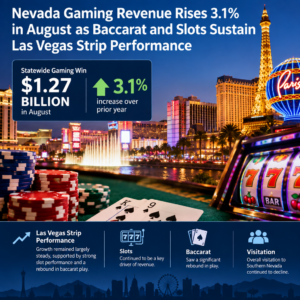 Nevada’s nonrestricted gaming licensees reported a statewide gaming win of approximately $1.27 billion in August, a 3.1% increase over the prior year, according to the Nevada Gaming Control Board. Growth on the Las Vegas Strip remained largely steady, supported by strong slot performance and a significant rebound in baccarat play, even as overall visitation to Southern Nevada continued to decline.
Statewide gaming win for August totaled $1,266,105,114, up 3.14% from August of the prior year, when licensees reported $1,227,573,173. The increase was modest relative to performance in other months of the current fiscal year, but industry analysts noted that the result reflects resilience in core gaming categories amid a softer tourism environment.
The statewide figure encompassed 453 operating casinos across Nevada’s gaming regions, including the Las Vegas Strip, downtown Las Vegas, and the state’s regional markets.
Strip Performance Driven by Tables and Slots
Las Vegas Strip properties posted gaming win of $684.1 million for the month, a modest increase year over year. The Strip’s performance was underpinned by two primary categories:
-
Baccarat: Strip baccarat win reached $155 million, an increase of 34.1% compared with the same month in the prior year. The growth in baccarat alone contributed an additional $39.4 million to casino winnings.
-
Slot machines: Slot play on the Strip held firm, providing a stable revenue base that offset variability in table game hold.
The baccarat rebound is a noteworthy indicator for industry professionals, as the game remains closely tied to international premium play. Sustained strength in baccarat volume can signal renewed confidence among high-end players, a segment that has fluctuated considerably in recent years.
A Mixed Picture for Tourism
While gaming win improved, the underlying visitation data told a more complicated story. Southern Nevada recorded a decline in visitor volume for the month, and Strip revenue growth largely stalled when viewed alongside broader tourism metrics. Analysts observed that the Strip’s monthly gain was driven more by game mix and favorable hold than by increased customer traffic.
This dynamic underscores an ongoing trend in the market: gaming revenue has remained comparatively stable even as visitation softens, suggesting that operators have been able to maintain or grow per-visitor spending. However, sustained growth will likely depend on stabilizing visitor volume, particularly in midweek and convention-driven segments.
Outside the Strip, Nevada’s regional markets, including downtown Las Vegas and the Reno-Sparks area, supported the statewide increase. Slot-centric markets continued to deliver consistent results, reinforcing the sector’s role as a dependable revenue foundation for operators with diversified portfolios across the state.
Pennsylvania Attorney General Orders Removal of Skill Game Machines by October 14
 Pennsylvania Attorney General Dave Sunday has issued a formal warning to business owners statewide, advising them to remove unlicensed skill game terminals from their establishments before the October 14 deadline or risk enforcement action. The directive follows the Pennsylvania Supreme Court’s June ruling that skill game machines constitute illegal gambling devices under state law, setting in motion a 120-day window for compliance and leaving the General Assembly with limited time to intervene.
The Court Ruling Behind the Deadline
In June, the Pennsylvania Supreme Court determined that skill games – electronic terminals found in bars, convenience stores, gas stations, social clubs, and fire halls across the Commonwealth – are slot machines under Pennsylvania’s Gaming Control framework. The Office of Attorney General argued before the court that embedding an element of so-called skill into the games does not exempt the devices from the state’s gambling statutes.
The court stayed enforcement of its ruling for 120 days, establishing an October 13 compliance date and giving businesses and legislators time to respond. Absent legislative or judicial intervention before that date, the machines must be disabled and removed.
Enforcement Warning Issued
With the deadline approaching, Attorney General Sunday notified businesses that those continuing to operate skill game terminals after October 14 risk law enforcement action. The Pennsylvania State Police have issued parallel warnings, advising establishments that they could face penalties for operating the machines once the stay expires.
The Attorney General’s office has also emphasized that the ruling does not apply to machines regulated and licensed by the Pennsylvania Gaming Control Board, leaving a clear distinction between lawful, regulated devices and the unlicensed terminals now subject to removal.
Legislative Uncertainty Persists
The ruling has placed renewed pressure on state lawmakers, who have debated for years how – or whether – to regulate the machines. Proposals under consideration have ranged from taxation and licensing frameworks to outright prohibition. If the General Assembly does not act before the compliance date, businesses hosting the terminals must power them down, and the machines could be subject to seizure.
The stakes are significant for host establishments. Skill game revenue has become a meaningful income stream for many small businesses, veterans’ organizations, and fraternal clubs, and some operators have already begun removing machines in anticipation of the deadline.
Industry stakeholders and manufacturers have maintained that the games involve genuine elements of skill, a position the Supreme Court rejected. Regulators and law enforcement officials, meanwhile, have pointed to concerns over unregulated gambling proceeds, associated criminal activity, and the absence of consumer protections that apply to licensed gaming.
Dutch Licensed Gambling Operators Take Meta to Court Over Surge in Illegal Advertising
 The Dutch trade association for licensed online gambling operators, VNLOK (Vergunde Nederlandse Online Kansspelaanbieders), has filed a lawsuit against Meta Platforms, accusing the company of failing to prevent illegal gambling operators from advertising to Dutch consumers on Facebook and Instagram. The association has simultaneously lodged a formal complaint with the European Commission, escalating a dispute that reflects growing friction between regulated gambling markets and major technology platforms.
The Core of the Dispute
According to research conducted by VNLOK, more than 70,000 gambling-related advertisements appeared across Meta’s platforms during the fourth quarter of 2025. The association estimates that over 95% of these advertisements were placed by operators without a license from the Dutch gambling regulator, the Kansspelautoriteit (KSA).
Of particular concern to the association is the reported removal rate. VNLOK states that Meta removed fewer than 5% of the illegal advertisements, despite the company’s own advertising policies requiring gambling advertisers to obtain prior authorization and comply with applicable local regulations.
The association has characterized Meta’s measures as inadequate, noting that the platforms’ apparent inaction affects vulnerable groups, with younger users increasingly exposed to promotions from unlicensed operators. The Netherlands prohibits the targeting of adults aged 18 to 23 with gambling advertising due to their heightened vulnerability to gambling-related harm.
A Pattern of Limited Engagement
VNLOK has stated that Meta has declined for an extended period to engage in discussions regarding its advertising policy as it applies to the Dutch market. This lack of communication, combined with the volume of illegal advertisements observed, prompted the association to pursue both legal action at the national level and a complaint to the European Commission, where the matter intersects with obligations under the Digital Services Act (DSA), the EU framework governing platform responsibilities for illegal content.
The Dutch action is not an isolated case. Earlier in the year, the United Kingdom Gambling Commission publicly criticized Meta for what it described as insufficient action against illegal online casinos advertising on its platforms. The UK regulator reported thousands of illegal gambling advertisements in a single month, and accounts of its engagement with Meta have drawn attention to the practical burden placed on regulators to identify and report violations themselves.
Broader Context for the Regulated Market
The dispute carries significant implications for the Netherlands’ regulated online gambling sector. Licensed operators argue that widespread illegal advertising undermines the channelization objective of the Dutch regulatory framework – the principle that consumers should be directed toward licensed, supervised operators where consumer protections, responsible gambling measures, and tax obligations apply. When unlicensed operators gain visibility through major advertising channels, the competitive balance between regulated and unregulated providers is distorted.
Independent research analyzing Meta’s advertising archive has added weight to these concerns, with one analysis indicating that illegal gambling advertisements reached an estimated 38 million Dutch user accounts.
Novig Valuation Quadruples to $2 Billion as Prediction Markets Draw Investor Interest
 Novig, the sports-focused prediction-market platform, has closed a new funding round that values the company at approximately $2 billion, quadrupling its valuation from earlier this year, according to reports from The Wall Street Journal and other outlets. The development underscores accelerating investor appetite for prediction markets, even as the sector continues to navigate regulatory uncertainty.
From $500 Million to $2 Billion
The new valuation represents a substantial jump from February, when Novig raised a $75 million Series B led by Pantera Capital at a $500 million post-money valuation. Prior to that round, the company had raised an $18 million Series A in August 2025 at a $90 million valuation, bringing its total funding to more than $100 million before the latest raise.
Novig, founded by Jacob Fortinsky and Kelechi Ukah, operates a peer-to-peer sports trading platform that allows users to buy and sell sports contracts at market-driven prices rather than against a house edge. The company describes itself as a commission-free alternative to traditional sportsbooks and has received approval from the Commodity Futures Trading Commission (CFTC), the federal agency that regulates derivatives markets in the United States.
High-Profile Marketing and Celebrity Partnership
The platform has attracted significant attention for its marketing approach, including a partnership with actress Sydney Sweeney, who joined the company as an equity partner ahead of the fall and winter sports season. Sweeney appeared in Novig’s widely discussed “Just Sports” advertising campaign, which generated substantial publicity alongside criticism from some audiences. Forbes recently examined the campaign as part of a broader trend of companies embracing provocative, attention-driven marketing – sometimes described as “rage bait” – to build brand awareness in competitive consumer categories.
The strategy appears to have coincided with strong commercial momentum. According to New York Post reporting, the campaign was credited with helping drive growth among young male consumers, a demographic that has become a focal point for both sportsbooks and prediction-market operators.
A Crowded and Rapidly Evolving Sector
Novig’s funding round comes amid intense competition in the prediction-markets space. Rivals such as Kalshi and Polymarket have also attracted substantial investment as event-contract trading expands beyond politics into sports, entertainment, and financial outcomes. CNBC reported in June that Novig had secured CFTC approval as competition intensified across the category, describing the sector as experiencing a period of rapid expansion.
Industry observers note that the category’s growth is occurring against a backdrop of unresolved regulatory questions. While CFTC oversight provides a federal framework for event contracts, state-level regulators and gaming authorities continue to evaluate how sports prediction markets interact with existing sports-betting laws. Legal and operational uncertainty remains a material consideration for investors and operators alike.
Brazilian Football Clubs Push Back Against Lula’s Online Betting Ban
 Brazil’s leading football clubs have aligned themselves with sports betting operators in opposition to a sweeping government decree that bans online gambling, a measure that threatens to strip clubs of some of their most valuable commercial partnerships. President Luiz Inácio Lula da Silva signed the order banning fixed-odds sports betting and online casino games on September 25, just over a week before the first round of the presidential election, prompting an immediate and coordinated response from the sports industry.
The Scope of the Decree
The measure prohibits the offering, brokering, and advertising of online betting nationwide. Under the timetable set out by the government, betting websites and applications must be taken offline on October 6. New deposits have already been barred, and users have until October 5 to withdraw any remaining balances, with operators required to provide banks with account details to facilitate refunds. App stores and network providers are expected to remove or block access to betting platforms.
The decree requires approval by Congress within 120 days to remain in force, leaving a narrow but significant window in which lawmakers could reverse or amend the measure.
Commercial Exposure Across Série A
The financial stakes for Brazilian football are considerable. Betting companies are the principal sponsors of 14 of the 20 clubs in the top flight, having paid approximately $220.7 million in sponsorship deals. Corinthians has indicated it expects to lose close to $93 million as a result of the restrictions. Flamengo holds the largest individual arrangement in Brazilian football, an annual deal with Betano reported at R$268.5 million.
The impact, however, is uneven across the league. Industry analyses indicate that betting sponsorships account for roughly seven percent of clubs’ total revenues on average, with Flamengo showing the highest reliance at 12.85 percent. Clubs have nevertheless warned that the sudden withdrawal of these funds – combined with the loss of future commercial development in the sector – could push some organizations toward insolvency.
A meeting between club representatives and the government to discuss the measure was postponed, while operators have reportedly threatened legal action against the decision.
The administration has justified the ban primarily on public health and consumer protection grounds, citing rising gambling addiction and the accumulation of household debt linked to online betting. President Lula had criticized the industry publicly in the days preceding the decree, including remarks at the United Nations General Assembly in which he accused betting operators of fueling addiction.
Critics of the timing have noted that the order was announced days before an election in which the president is seeking another term, and after lawmakers – including members of the Liberal Party – had previously struck down proposed tax increases on online betting and virtual casinos.
Macau GGR Falls 1.2% Year-on-Year to US$2.24 Billion in September
 Macau’s casino gross gaming revenue (GGR) declined 1.2 percent year-on-year in September to approximately MOP18.1 billion (US$2.24 billion), extending the market’s run of annual declines to four consecutive months and recording the lowest monthly total of 2026, according to figures published by the Gaming Inspection and Coordination Bureau (DICJ).
The result continues a softer second half for the world’s largest gaming hub. Revenue had already slipped 1.2 percent year-on-year in August to MOP21.89 billion (US$2.71 billion), the third monthly decline, while June registered a steeper 12.1 percent drop to MOP18.5 billion (US$2.29 billion), a period analysts linked in part to the impact of the FIFA World Cup on visitation and spending patterns.
The September figure also fell short of earlier expectations. Analysts had entered the month anticipating a rebound, with forecasts of year-on-year growth in the region of 12 percent, before sentiment weakened. Citi revised its September GGR forecast downward by roughly 10 percent in the final week of the month, reflecting softer daily run rates observed across the market.
Cumulative Performance Still Positive
Despite the recent sequence of declines, Macau’s market remains in growth territory on a year-to-date basis. GGR for the first six months of 2026 reached MOP126.9 billion (US$15.7 billion), a 6.8 percent year-on-year increase, and the first eight months of the year were up 3.7 percent compared with the same period in 2025.
The September result, however, narrows that cushion considerably. It now falls to the fourth quarter to sustain the trajectory required to meet the government’s full-year forecast of MOP236 billion (US$29.43 billion) in casino GGR. The quarterly comparison will be complicated by the fact that the year’s early momentum was substantial: January opened at MOP22.6 billion and the first quarter grew more than 14 percent year-on-year.
Structural Considerations for Operators
Industry observers continue to weigh two competing narratives. On one hand, the pullback may reflect temporary or event-driven headwinds, including the World Cup’s diversion of consumer spending and elevated prior-year comparisons. On the other, structural metrics remain below pre-pandemic benchmarks, with gaming revenue per visitor in the first eight months of 2026 estimated at roughly 19 percent below equivalent pre-pandemic levels – a signal that shifts in customer mix, particularly toward lower-spending segments, may be weighing on per-capita yields.
For operators, the pressure on margins identified earlier in the year may persist if the softer run rate extends into the Golden Week holiday period and beyond, a stretch that has historically been decisive for fourth-quarter performance.
UK Gambling Commission Introduces New Gaming Machine Rules
 The Gambling Commission has announced new rules governing gaming machines, designed to ensure that non-compliant machines are removed from premises quickly and effectively. The changes, followed a consultation process, are intended to strengthen consumer protection while providing licensed operators with clearer, more consistent requirements. Below is the full announcement from the UKGC:
New standards to make gaming machines fairer and safer for consumers are to be introduced.
Changes include:
- new category B gaming machines must provide consumers with improved access to gambling management tools and sessional information detailing how long they have been playing for and how much they have won or lost
- sessional information will be available to licensees to support them in meeting regulatory obligations such as interacting with consumers who are displaying signs of gambling harm
- improvements in responsible game design by ensuring awards below the stake size are not celebrated and prohibiting features that permit a customer to reduce the time until a result is known.
The new changes follow a consultation to implement proposals from the 2023 Gambling Act Review White Paper High stakes: gambling reform for the digital age (opens in new tab).
During the consultation process the Commission considered the evidence provided and made changes to the original proposals to take account of practical and technical considerations and reduce the risk of unintended consequences.
Existing gaming machines will be exempt from the new requirements due to the complex technical changes and costs to business that would not necessarily deliver proportionate consumer benefits. In addition, steps have been taken to reduce the risk of consumer and staff ‘alert fatigue’ and to protect consumer privacy.
There will be a staged implementation with the bulk of the changes coming into effect in June 2027.
Helen Rhodes, Director of Major Policy Projects and Evaluation, said:
“These measures will help both to empower consumers to understand and manage their gambling and ensure operators play their part.
“Consultation feedback from a range of stakeholders helped to inform our thinking and where there was legitimate and evidenced concern, we made changes. We are confident that the consultation has led to a package of changes where the benefits to consumers are proportionate to the costs of implementation and that the staged timeline for implementation is reasonable and achievable.”