



Pennsylvania Attorney General Orders Removal of Skill Game Machines by October 14
 Pennsylvania Attorney General Dave Sunday has issued a formal warning to business owners statewide, advising them to remove unlicensed skill game terminals from their establishments before the October 14 deadline or risk enforcement action. The directive follows the Pennsylvania Supreme Court’s June ruling that skill game machines constitute illegal gambling devices under state law, setting in motion a 120-day window for compliance and leaving the General Assembly with limited time to intervene.
The Court Ruling Behind the Deadline
In June, the Pennsylvania Supreme Court determined that skill games – electronic terminals found in bars, convenience stores, gas stations, social clubs, and fire halls across the Commonwealth – are slot machines under Pennsylvania’s Gaming Control framework. The Office of Attorney General argued before the court that embedding an element of so-called skill into the games does not exempt the devices from the state’s gambling statutes.
The court stayed enforcement of its ruling for 120 days, establishing an October 13 compliance date and giving businesses and legislators time to respond. Absent legislative or judicial intervention before that date, the machines must be disabled and removed.
Enforcement Warning Issued
With the deadline approaching, Attorney General Sunday notified businesses that those continuing to operate skill game terminals after October 14 risk law enforcement action. The Pennsylvania State Police have issued parallel warnings, advising establishments that they could face penalties for operating the machines once the stay expires.
The Attorney General’s office has also emphasized that the ruling does not apply to machines regulated and licensed by the Pennsylvania Gaming Control Board, leaving a clear distinction between lawful, regulated devices and the unlicensed terminals now subject to removal.
Legislative Uncertainty Persists
The ruling has placed renewed pressure on state lawmakers, who have debated for years how – or whether – to regulate the machines. Proposals under consideration have ranged from taxation and licensing frameworks to outright prohibition. If the General Assembly does not act before the compliance date, businesses hosting the terminals must power them down, and the machines could be subject to seizure.
The stakes are significant for host establishments. Skill game revenue has become a meaningful income stream for many small businesses, veterans’ organizations, and fraternal clubs, and some operators have already begun removing machines in anticipation of the deadline.
Industry stakeholders and manufacturers have maintained that the games involve genuine elements of skill, a position the Supreme Court rejected. Regulators and law enforcement officials, meanwhile, have pointed to concerns over unregulated gambling proceeds, associated criminal activity, and the absence of consumer protections that apply to licensed gaming.
Dutch Licensed Gambling Operators Take Meta to Court Over Surge in Illegal Advertising
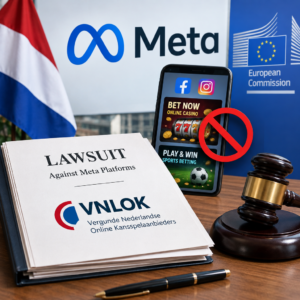 The Dutch trade association for licensed online gambling operators, VNLOK (Vergunde Nederlandse Online Kansspelaanbieders), has filed a lawsuit against Meta Platforms, accusing the company of failing to prevent illegal gambling operators from advertising to Dutch consumers on Facebook and Instagram. The association has simultaneously lodged a formal complaint with the European Commission, escalating a dispute that reflects growing friction between regulated gambling markets and major technology platforms.
The Core of the Dispute
According to research conducted by VNLOK, more than 70,000 gambling-related advertisements appeared across Meta’s platforms during the fourth quarter of 2025. The association estimates that over 95% of these advertisements were placed by operators without a license from the Dutch gambling regulator, the Kansspelautoriteit (KSA).
Of particular concern to the association is the reported removal rate. VNLOK states that Meta removed fewer than 5% of the illegal advertisements, despite the company’s own advertising policies requiring gambling advertisers to obtain prior authorization and comply with applicable local regulations.
The association has characterized Meta’s measures as inadequate, noting that the platforms’ apparent inaction affects vulnerable groups, with younger users increasingly exposed to promotions from unlicensed operators. The Netherlands prohibits the targeting of adults aged 18 to 23 with gambling advertising due to their heightened vulnerability to gambling-related harm.
A Pattern of Limited Engagement
VNLOK has stated that Meta has declined for an extended period to engage in discussions regarding its advertising policy as it applies to the Dutch market. This lack of communication, combined with the volume of illegal advertisements observed, prompted the association to pursue both legal action at the national level and a complaint to the European Commission, where the matter intersects with obligations under the Digital Services Act (DSA), the EU framework governing platform responsibilities for illegal content.
The Dutch action is not an isolated case. Earlier in the year, the United Kingdom Gambling Commission publicly criticized Meta for what it described as insufficient action against illegal online casinos advertising on its platforms. The UK regulator reported thousands of illegal gambling advertisements in a single month, and accounts of its engagement with Meta have drawn attention to the practical burden placed on regulators to identify and report violations themselves.
Broader Context for the Regulated Market
The dispute carries significant implications for the Netherlands’ regulated online gambling sector. Licensed operators argue that widespread illegal advertising undermines the channelization objective of the Dutch regulatory framework – the principle that consumers should be directed toward licensed, supervised operators where consumer protections, responsible gambling measures, and tax obligations apply. When unlicensed operators gain visibility through major advertising channels, the competitive balance between regulated and unregulated providers is distorted.
Independent research analyzing Meta’s advertising archive has added weight to these concerns, with one analysis indicating that illegal gambling advertisements reached an estimated 38 million Dutch user accounts.
Novig Valuation Quadruples to $2 Billion as Prediction Markets Draw Investor Interest
 Novig, the sports-focused prediction-market platform, has closed a new funding round that values the company at approximately $2 billion, quadrupling its valuation from earlier this year, according to reports from The Wall Street Journal and other outlets. The development underscores accelerating investor appetite for prediction markets, even as the sector continues to navigate regulatory uncertainty.
From $500 Million to $2 Billion
The new valuation represents a substantial jump from February, when Novig raised a $75 million Series B led by Pantera Capital at a $500 million post-money valuation. Prior to that round, the company had raised an $18 million Series A in August 2025 at a $90 million valuation, bringing its total funding to more than $100 million before the latest raise.
Novig, founded by Jacob Fortinsky and Kelechi Ukah, operates a peer-to-peer sports trading platform that allows users to buy and sell sports contracts at market-driven prices rather than against a house edge. The company describes itself as a commission-free alternative to traditional sportsbooks and has received approval from the Commodity Futures Trading Commission (CFTC), the federal agency that regulates derivatives markets in the United States.
High-Profile Marketing and Celebrity Partnership
The platform has attracted significant attention for its marketing approach, including a partnership with actress Sydney Sweeney, who joined the company as an equity partner ahead of the fall and winter sports season. Sweeney appeared in Novig’s widely discussed “Just Sports” advertising campaign, which generated substantial publicity alongside criticism from some audiences. Forbes recently examined the campaign as part of a broader trend of companies embracing provocative, attention-driven marketing – sometimes described as “rage bait” – to build brand awareness in competitive consumer categories.
The strategy appears to have coincided with strong commercial momentum. According to New York Post reporting, the campaign was credited with helping drive growth among young male consumers, a demographic that has become a focal point for both sportsbooks and prediction-market operators.
A Crowded and Rapidly Evolving Sector
Novig’s funding round comes amid intense competition in the prediction-markets space. Rivals such as Kalshi and Polymarket have also attracted substantial investment as event-contract trading expands beyond politics into sports, entertainment, and financial outcomes. CNBC reported in June that Novig had secured CFTC approval as competition intensified across the category, describing the sector as experiencing a period of rapid expansion.
Industry observers note that the category’s growth is occurring against a backdrop of unresolved regulatory questions. While CFTC oversight provides a federal framework for event contracts, state-level regulators and gaming authorities continue to evaluate how sports prediction markets interact with existing sports-betting laws. Legal and operational uncertainty remains a material consideration for investors and operators alike.
Brazilian Football Clubs Push Back Against Lula’s Online Betting Ban
 Brazil’s leading football clubs have aligned themselves with sports betting operators in opposition to a sweeping government decree that bans online gambling, a measure that threatens to strip clubs of some of their most valuable commercial partnerships. President Luiz Inácio Lula da Silva signed the order banning fixed-odds sports betting and online casino games on September 25, just over a week before the first round of the presidential election, prompting an immediate and coordinated response from the sports industry.
The Scope of the Decree
The measure prohibits the offering, brokering, and advertising of online betting nationwide. Under the timetable set out by the government, betting websites and applications must be taken offline on October 6. New deposits have already been barred, and users have until October 5 to withdraw any remaining balances, with operators required to provide banks with account details to facilitate refunds. App stores and network providers are expected to remove or block access to betting platforms.
The decree requires approval by Congress within 120 days to remain in force, leaving a narrow but significant window in which lawmakers could reverse or amend the measure.
Commercial Exposure Across Série A
The financial stakes for Brazilian football are considerable. Betting companies are the principal sponsors of 14 of the 20 clubs in the top flight, having paid approximately $220.7 million in sponsorship deals. Corinthians has indicated it expects to lose close to $93 million as a result of the restrictions. Flamengo holds the largest individual arrangement in Brazilian football, an annual deal with Betano reported at R$268.5 million.
The impact, however, is uneven across the league. Industry analyses indicate that betting sponsorships account for roughly seven percent of clubs’ total revenues on average, with Flamengo showing the highest reliance at 12.85 percent. Clubs have nevertheless warned that the sudden withdrawal of these funds – combined with the loss of future commercial development in the sector – could push some organizations toward insolvency.
A meeting between club representatives and the government to discuss the measure was postponed, while operators have reportedly threatened legal action against the decision.
The administration has justified the ban primarily on public health and consumer protection grounds, citing rising gambling addiction and the accumulation of household debt linked to online betting. President Lula had criticized the industry publicly in the days preceding the decree, including remarks at the United Nations General Assembly in which he accused betting operators of fueling addiction.
Critics of the timing have noted that the order was announced days before an election in which the president is seeking another term, and after lawmakers – including members of the Liberal Party – had previously struck down proposed tax increases on online betting and virtual casinos.
Macau GGR Falls 1.2% Year-on-Year to US$2.24 Billion in September
 Macau’s casino gross gaming revenue (GGR) declined 1.2 percent year-on-year in September to approximately MOP18.1 billion (US$2.24 billion), extending the market’s run of annual declines to four consecutive months and recording the lowest monthly total of 2026, according to figures published by the Gaming Inspection and Coordination Bureau (DICJ).
The result continues a softer second half for the world’s largest gaming hub. Revenue had already slipped 1.2 percent year-on-year in August to MOP21.89 billion (US$2.71 billion), the third monthly decline, while June registered a steeper 12.1 percent drop to MOP18.5 billion (US$2.29 billion), a period analysts linked in part to the impact of the FIFA World Cup on visitation and spending patterns.
The September figure also fell short of earlier expectations. Analysts had entered the month anticipating a rebound, with forecasts of year-on-year growth in the region of 12 percent, before sentiment weakened. Citi revised its September GGR forecast downward by roughly 10 percent in the final week of the month, reflecting softer daily run rates observed across the market.
Cumulative Performance Still Positive
Despite the recent sequence of declines, Macau’s market remains in growth territory on a year-to-date basis. GGR for the first six months of 2026 reached MOP126.9 billion (US$15.7 billion), a 6.8 percent year-on-year increase, and the first eight months of the year were up 3.7 percent compared with the same period in 2025.
The September result, however, narrows that cushion considerably. It now falls to the fourth quarter to sustain the trajectory required to meet the government’s full-year forecast of MOP236 billion (US$29.43 billion) in casino GGR. The quarterly comparison will be complicated by the fact that the year’s early momentum was substantial: January opened at MOP22.6 billion and the first quarter grew more than 14 percent year-on-year.
Structural Considerations for Operators
Industry observers continue to weigh two competing narratives. On one hand, the pullback may reflect temporary or event-driven headwinds, including the World Cup’s diversion of consumer spending and elevated prior-year comparisons. On the other, structural metrics remain below pre-pandemic benchmarks, with gaming revenue per visitor in the first eight months of 2026 estimated at roughly 19 percent below equivalent pre-pandemic levels – a signal that shifts in customer mix, particularly toward lower-spending segments, may be weighing on per-capita yields.
For operators, the pressure on margins identified earlier in the year may persist if the softer run rate extends into the Golden Week holiday period and beyond, a stretch that has historically been decisive for fourth-quarter performance.
UK Gambling Commission Introduces New Gaming Machine Rules
 The Gambling Commission has announced new rules governing gaming machines, designed to ensure that non-compliant machines are removed from premises quickly and effectively. The changes, followed a consultation process, are intended to strengthen consumer protection while providing licensed operators with clearer, more consistent requirements. Below is the full announcement from the UKGC:
New standards to make gaming machines fairer and safer for consumers are to be introduced.
Changes include:
- new category B gaming machines must provide consumers with improved access to gambling management tools and sessional information detailing how long they have been playing for and how much they have won or lost
- sessional information will be available to licensees to support them in meeting regulatory obligations such as interacting with consumers who are displaying signs of gambling harm
- improvements in responsible game design by ensuring awards below the stake size are not celebrated and prohibiting features that permit a customer to reduce the time until a result is known.
The new changes follow a consultation to implement proposals from the 2023 Gambling Act Review White Paper High stakes: gambling reform for the digital age (opens in new tab).
During the consultation process the Commission considered the evidence provided and made changes to the original proposals to take account of practical and technical considerations and reduce the risk of unintended consequences.
Existing gaming machines will be exempt from the new requirements due to the complex technical changes and costs to business that would not necessarily deliver proportionate consumer benefits. In addition, steps have been taken to reduce the risk of consumer and staff ‘alert fatigue’ and to protect consumer privacy.
There will be a staged implementation with the bulk of the changes coming into effect in June 2027.
Helen Rhodes, Director of Major Policy Projects and Evaluation, said:
“These measures will help both to empower consumers to understand and manage their gambling and ensure operators play their part.
“Consultation feedback from a range of stakeholders helped to inform our thinking and where there was legitimate and evidenced concern, we made changes. We are confident that the consultation has led to a package of changes where the benefits to consumers are proportionate to the costs of implementation and that the staged timeline for implementation is reasonable and achievable.”
Funding Shortfall Leaves Key Gambling Reforms Stalled, Irish Regulator Warns
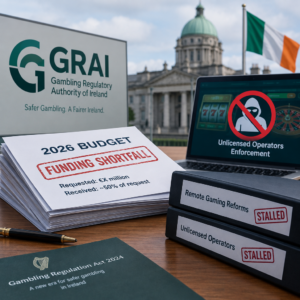 Ireland’s gambling regulator has warned that reforms covering remote gaming and the enforcement of unlicensed operators have stalled, citing a budget for 2026 that fell short of what the authority requested. The Gambling Regulatory Authority of Ireland (GRAI), the body established under the Gambling Regulation Act 2024 to overhaul gambling regulation in the State, received approximately half of the funding it sought for the current year, according to reporting by The Irish Times.
The development has significant implications for the pace of Ireland’s licensing regime, the most substantial regulatory change in the sector since the foundation of the State.
Background: A Phased Regulatory Transition
The GRAI has been rolling out the new regime in phases since its establishment. In February 2026, Minister for Justice Jim O’Callaghan signed a commencement order paving the way for the authority to open applications for remote and in-person betting licences. From 1 July 2026, GRAI licensing formally replaced Revenue’s oversight of betting operators, requiring both business-to-consumer and business-to-business operators to secure licences and comply with new standards covering background checks, premises inspections and other conditions.
However, the regime governing remote gaming – a category that covers online casino-style products – has yet to commence. Industry participants have been awaiting clarity on the timetable for these licences, which are expected to bring online casino operations into the regulated framework for the first time.
The Funding Constraint
According to the report, the authority has indicated that resourcing limitations have delayed progress on several fronts. Two areas of particular concern are:
-
Remote gaming licensing: The implementation of the licensing framework for online gaming products has not advanced as planned, leaving a significant segment of the market operating outside the new regime.
-
Enforcement against unlicensed operators: Efforts to tackle the black market, in which unlicensed websites target Irish consumers, have been constrained by limited capacity.
The authority has previously outlined plans to address illegal operators, including an application for “trusted flagger” status with Coimisiún na Meán, which would enable flagged websites to be taken down rapidly. The regulator has also moved to have Ireland geoblocked by certain offshore operators.
Implications for Operators
For licensed and prospective licensees, the funding shortfall introduces a measure of uncertainty. Betting operators that completed the July 2026 transition now face a competitive environment in which unlicensed remote gaming operators continue to reach Irish customers without bearing the cost of compliance. Licensed firms have consistently argued that effective enforcement is essential to maintaining a level playing field.
At the same time, the GRAI’s phased approach reflects the scale of the task involved: the authority is simultaneously building its institutional capacity, processing licence applications, and developing consumer protection measures under the 2024 Act, including advertising restrictions and safeguards for vulnerable customers.
Georgia Moves Forward With International iGaming Licensing Framework
 Georgia is developing a dedicated licensing framework for international online gambling operators, with details emerging that point to a regime designed specifically for companies serving customers outside the country. According to reporting by Focus Gaming News, the framework is intended to offer international gambling licences to operators targeting overseas players, supported by a competitive tax rate and dedicated banking arrangements.
A Regulatory Regime Built for International Operators
The emerging framework distinguishes itself from Georgia’s existing domestic gambling regulation by focusing exclusively on operators whose customer base is located abroad. Rather than opening the local market to additional competition, the proposal appears modelled on the international licensing jurisdictions that have become established features of the global iGaming landscape – jurisdictions that regulate the operator while permitting the licence holder to serve players in other markets.
Key elements reported so far include:
-
International licences enabling operators to target players outside Georgia’s borders
-
A competitive tax rate, positioned to make the jurisdiction cost-effective relative to established licensing centres
-
Banking and payment provisions integrated into the framework, addressing one of the persistent operational challenges for internationally licensed operators
The combination of licensing, banking, and payment arrangements within a single framework is a notable detail. For many operators seeking international licences, securing reliable banking relationships can prove as difficult as obtaining regulatory approval itself, and jurisdictions that formalise this element within their licensing regime may hold a practical advantage.
Part of a Broader Ambition
The development aligns with reports from earlier in the year that Georgia was considering legislation to establish a dedicated licensing regime for online gambling operators serving foreign customers, with the stated aim of positioning the country as an international gambling hub.
Georgia already hosts a substantial domestic gambling industry and a growing cluster of iGaming technology and content businesses. A formal international licensing regime would represent a shift from serving the domestic market toward competing directly with established offshore and international jurisdictions for operator registrations.
Balanced Considerations
For operators, the framework’s appeal will depend on the details that have not yet been fully disclosed, including the application requirements, compliance obligations, responsible gambling standards, and the precise tax treatment of gross gaming revenue. Jurisdictions offering low headline tax rates have faced increasing scrutiny from regulators in target markets, and operators must weigh any cost advantage against the reputational and regulatory realities of where their players are located.
The inclusion of banking arrangements may also signal an attempt to address the concerns that have historically limited the legitimacy of some international licence jurisdictions. Formalising financial infrastructure within the regulatory framework could improve transparency and provide operators with greater operational certainty.
At the same time, the competitive landscape for international licences remains crowded, with jurisdictions across Europe, the Caribbean, and Asia-Pacific continually refining their own offerings. Georgia’s success will depend on whether the final framework delivers genuine regulatory credibility alongside its commercial incentives.
SkyCity Advances Toward Sale of Adelaide Casino
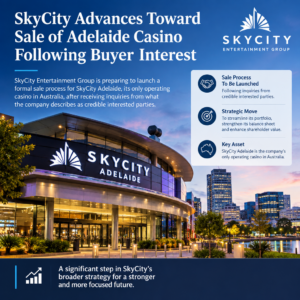 SkyCity Entertainment Group is preparing to launch a formal sale process for SkyCity Adelaide, its only operating casino in Australia, after receiving inquiries from what the company describes as credible interested parties. The move represents a significant step in the New Zealand-listed operator’s broader strategy to streamline its portfolio, strengthen its balance sheet and enhance shareholder value.
Background to the Decision
The decision follows a period of sustained scrutiny of the Adelaide business. SkyCity Adelaide settled a South Australian regulatory review in June 2026 with an AU$14.7 million fine and a series of new governance commitments. While the settlement provided a degree of regulatory certainty, it added to the pressures facing the Australian asset, which has also contended with softer trading conditions.
At the same time, SkyCity’s board has been pursuing a wider program of asset monetisation and cost reduction. In August 2026, the group reported a 22.3 percent decline in underlying EBITDA, citing macroeconomic headwinds, and confirmed that asset sales and cost-out initiatives would form a central part of its path forward. On 25 August 2026, the company announced it was commencing a structured process to assess transactions across the group, with a focus on securing regulatory certainty for the Adelaide business.
Advisers and Process Details
SkyCity has engaged investment bank UBS and law firm Chapman Tripp to advise on the sale process and related strategic options. According to market reporting, UBS is expected to begin the formal sale process in the coming weeks, with proposals to be sought from a range of potential buyers.
Broker Forsyth Barr, which had publicly argued in September 2026 that the time was right for SkyCity to divest the loss-making Adelaide operation, has estimated the business could fetch between NZ$180 million and NZ$200 million. The company has not confirmed any valuation or named prospective bidders, and it remains unclear whether any transaction would involve the casino licence, the property, or both.
Operational Context
Despite the financial pressures at group level, the Adelaide business has shown areas of underlying resilience. In the group’s FY2026 results, SkyCity Adelaide’s electronic gaming machine market share improved from 7.9 percent in June 2025 to 8.3 percent at June 2026, while non-gaming revenue rose 3.9 percent for the year. The venue operates as an integrated entertainment destination, incorporating gaming facilities, the Eos by SkyCity hotel, and multiple food and beverage outlets.
Balancing Considerations
A divestment would mark a strategic retreat from Australia for SkyCity, which operates casinos in Auckland, Hamilton and Queenstown in addition to the Adelaide property. Supporters of a sale argue that exiting a loss-making, capital-intensive Australian asset would allow the group to concentrate resources on its core New Zealand operations and reduce balance sheet strain. However, any transaction will require regulatory approval in South Australia, where the casino licence is subject to ongoing oversight, and prospective buyers will need to satisfy licensing requirements.
MGM and People Inc. Takeover Talks Flip as MGM Weighs Counter-Bid
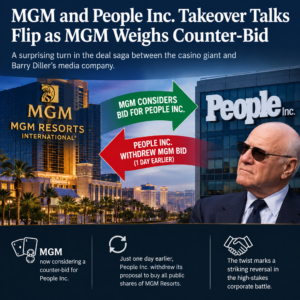 Takeover negotiations between MGM Resorts International and People Incorporated have taken an unexpected turn, with new reporting indicating that MGM is now considering a bid to acquire the media company controlled by Barry Diller. The development comes just one day after People Inc. withdrew its own proposal to purchase all public shares of MGM Resorts, marking a striking reversal in a corporate saga that began earlier this year.
According to a report by The Wall Street Journal, citing people familiar with the matter, MGM Resorts is weighing a potential takeover offer for People Inc. that could materialize in the coming days. The reported discussions represent a direct inversion of the original dynamic, in which People Inc. – the media group behind People magazine and a substantial shareholder in MGM – sought to take the casino operator private.
The Withdrawal of the Original Proposal
On September 23, 2026, People Incorporated announced it had withdrawn its proposal to purchase all outstanding public shares of MGM Resorts International. The bid, first submitted in June, had valued the casino operator at more than $18 billion, with an offer price of $48.30 per share. At the time of the proposal, People Inc. held a stake of approximately 27 percent in MGM Resorts, making it one of the company’s largest shareholders.
In a statement, Barry Diller, chairman of People Inc., acknowledged that the negotiations had not progressed as anticipated. “We didn’t feel the mix was coming together in the way we had hoped and have decided not to pursue taking the company private at this time,” Diller said. He indicated, however, that People Inc. remains interested in pursuing a strategic transaction with MGM.
MGM Resorts’ Board of Directors responded the same day, confirming People Inc.’s withdrawal and reiterating the company’s commitment to executing its strategy as a standalone business.
Market Reaction
Investor sentiment shifted sharply following the withdrawal. MGM Resorts shares declined by approximately 10 to 11 percent in the sessions following the announcement, erasing gains accumulated since the buyout proposal was first disclosed in June. The share price movement underscores the degree to which the market had priced in the prospect of a take-private transaction.
A Potential Role Reversal
The prospect of MGM Resorts bidding for People Inc. would represent a notable departure from the conventional pattern in such negotiations. Analysts have observed that the original proposal – an unusual move for a media company seeking to acquire a major casino operator – had already drawn attention for its atypical structure. A counter-offer from MGM would extend that unconventional character.
The reversal also highlights the strategic interdependence between the two companies. People Inc.’s substantial stake in MGM has been financially significant for the media group, which reported a quarterly profit of $506.9 million in August, boosted in part by an unrealized gain on its MGM investment. Any transaction between the two parties would therefore carry implications for both companies’ balance sheets and strategic positioning.
It should be noted that no formal bid from MGM Resorts has been confirmed, and the Wall Street Journal report is based on unnamed sources. MGM’s Board has publicly affirmed its commitment to the standalone strategy, and there is no guarantee that discussions will result in a transaction. People Inc., for its part, has expressed continued interest in a strategic arrangement rather than a complete acquisition.