



Ohio Leads 39-State Coalition Urging Supreme Court Review of Prediction Market Case



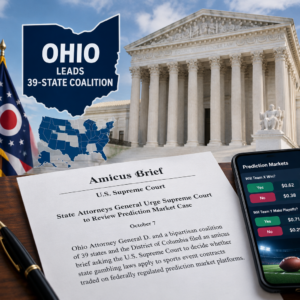 Ohio is spearheading a bipartisan coalition of 39 states and the District of Columbia asking the U.S. Supreme Court to decide whether state gambling laws apply to sports event contracts traded on federally regulated prediction market platforms.
In an amicus brief filed October 7 in the Supreme Court docket for New Jersey’s case against KalshiEX LLC, the state attorneys general – led by Ohio Attorney General D. Andrew Wilson – argue that conflicting appellate rulings have created legal uncertainty that undermines states’ traditional authority to regulate gambling within their borders.
A Deepening Circuit Split
The dispute centers on a question with significant implications for the rapidly growing prediction market industry: whether sports-related event contracts are “swaps” under the Commodity Exchange Act, which would place them under the exclusive jurisdiction of the Commodity Futures Trading Commission (CFTC), or gambling instruments subject to state regulation.
The federal courts of appeals have split on the issue. In April 2026, a divided Third Circuit held that sports event contracts traded on a CFTC-registered designated contract market are swaps, finding Kalshi likely to prevail on its preemption arguments. The Sixth Circuit reached the opposite conclusion in September 2026, when a unanimous three-judge panel ruled that Kalshi failed to show its sports contracts qualify as swaps and that Ohio and Tennessee may enforce their gambling laws against the platform.
The Sixth Circuit’s ruling affirmed the denial of Kalshi’s preliminary injunction in Ohio and vacated the injunction the company had obtained in Tennessee, remanding both cases for further proceedings.
In their brief, the states contend that a ruling in Kalshi’s favor could limit their ability to apply gambling licensing requirements, age restrictions, and consumer protections to sports event contracts. The coalition also argues that prediction markets effectively offer sports wagering outside the state-by-state regulatory framework established after the 2018 repeal of the federal ban on sports betting.
Ohio has been active on the issue throughout the year. In April 2026, then-Attorney General Dave Yost led a similar multi-state effort, submitting a letter responding to the CFTC’s request for public comment on proposed prediction market rules and urging the commission to recognize state authority over sports wagering.
Industry and Federal Stakes
Kalshi maintains that its contracts function as regulated financial derivatives rather than bets, and the CFTC has supported the company’s position, including through an amicus brief. The commission has simultaneously advanced its own regulatory framework for prediction markets, issuing proposed rules for public comment earlier in 2026.
The coalition’s filing follows a petition from New Jersey asking the Supreme Court to take up the matter, and it was joined by amicus support from the NFL. A separate brief filed in the case on behalf of Kalshi and other prediction market operators argues that the exclusive-jurisdiction provision of the Commodity Exchange Act preempts state sports gambling laws.