



Sixth Circuit Rules Against Kalshi, Allowing States To Regulate Prediction Markets



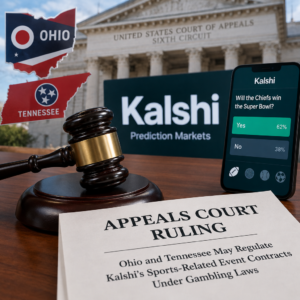 A federal appeals court has dealt a significant setback to prediction market operator Kalshi, ruling that states Ohio and Tennessee may regulate the company’s sports-related event contracts under their respective gambling laws. The decision, issued Friday by the 6th U.S. Circuit Court of Appeals, is the second appellate ruling against the company in less than a month and deepens a widening split among federal courts that legal observers expect could ultimately be resolved by the U.S. Supreme Court.
Kalshi operates a prediction market registered with the Commodity Futures Trading Commission (CFTC), the federal agency that oversees derivatives trading in the United States. The company has offered “event contracts” allowing users to trade on the outcomes of sporting events and other occurrences. Kalshi has long maintained that, as a federally registered exchange, its activity falls exclusively under the Commodity Exchange Act and therefore cannot be subjected to state gambling regulation.
That position was challenged after multiple state gaming regulators, including Ohio and Tennessee, issued cease-and-desist letters directing Kalshi to stop offering sports-related contracts within their borders. Kalshi responded by suing, seeking to block state enforcement on the grounds of federal preemption.
A Deepening Circuit Split
The Sixth Circuit’s ruling follows a series of conflicting appellate decisions that have fractured the legal landscape for the prediction markets industry.
In April, the 3rd U.S. Circuit Court of Appeals ruled in Kalshi’s favor, holding that the CFTC has exclusive jurisdiction over sports-related event contracts and that state regulators could not interfere. That decision was regarded as a landmark victory for the industry.
However, in late August, the 9th U.S. Circuit Court of Appeals reached the opposite conclusion, determining that sports-related event contracts do not qualify as swaps under federal law and that Nevada gaming regulators may proceed with oversight of such offerings. The Ninth Circuit panel rejected what it characterized as Kalshi’s overly broad reading of the Commodity Exchange Act.
The Sixth Circuit’s decision now aligns with the Ninth Circuit and against the Third Circuit, creating a formal circuit split. Notably, New Jersey has already petitioned the U.S. Supreme Court to review the question of whether states may regulate prediction markets’ sports wagering, and federal regulators have acknowledged that the divergent rulings may call for resolution by the nation’s highest court.
Implications for the Industry
The cumulative effect of the recent rulings presents substantial operational and regulatory uncertainty for Kalshi and comparable platforms, including Polymarket. Depending on how the circuit split is resolved, operators could face a fragmented regulatory environment in which states treat sports event contracts as gambling subject to licensing and oversight, or a unified framework in which the CFTC retains exclusive authority.
For state regulators, the Sixth and Ninth Circuit decisions represent an affirmation of their authority to police unlicensed wagering activity within their borders. For prediction market operators and their exchanges, the rulings raise the prospect of enforcement actions, market withdrawals in certain states, and increased compliance burdens.