



South Carolina Governor Race Take Opposing Stances on Casino Gambling



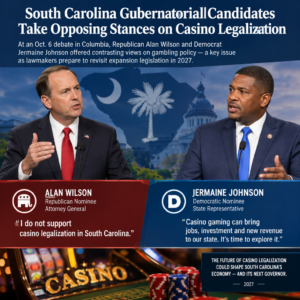 The race to become South Carolina’s next governor has surfaced a clear divide on gambling policy. During an Oct. 6 debate in Columbia, Republican nominee and Attorney General Alan Wilson and Democratic nominee State Rep. Jermaine Johnson offered contrasting positions on casino legalization, a question with growing relevance as lawmakers prepare to revisit expansion legislation in 2027.
A Defining Moment at the Debate
When asked whether they would support allowing casinos in South Carolina if voters approved the measure through a statewide referendum, the two candidates parted ways visibly. Johnson signaled his support, indicating he would defer to the will of the electorate. Wilson declined, taking the position that he would oppose casino gambling even if a majority of voters endorsed it.
The exchange highlighted a distinction that has run throughout the campaign: Johnson favors letting South Carolina residents decide the question directly, while Wilson draws a firm line against brick-and-mortar casinos regardless of public sentiment.
Divergence on Casinos, Common Ground on Sports Betting
Despite their disagreement on casinos, the candidates are not far apart on another form of gambling. Wilson has expressed support for legalizing online sports betting, provided it includes regulatory safeguards. Johnson has also signaled openness to gambling expansion discussions, framing the issue as one best resolved by voters.
That nuance matters for industry observers. A Wilson administration could theoretically advance regulated online sports wagering while blocking casino development, whereas a Johnson administration would be more receptive to a broader expansion framework, contingent on a referendum.
Legislative Context
The debate comes at a pivotal time for gambling policy in the state. South Carolina currently permits no commercial casinos, and sports betting remains illegal. However, recent legislative sessions have shown increasing activity on the issue:
-
House Bill 4176, the “I-95 Economic and Education Stimulus Act,” would have authorized a single state-regulated casino in an economically distressed county, with a proposed site at a long-vacant mall location in Orangeburg County near Interstate 95.
-
The measure reached the House floor in 2025 but failed to advance in 2026, and proponents are expected to reintroduce it in 2027.
-
Separate proposals to legalize online sports wagering have been introduced in the General Assembly, though none have been enacted.
The outgoing administration has been a consistent obstacle. Gov. Henry McMaster has opposed gambling expansion throughout his tenure, including measures to permit horse race wagering or casino development. With McMaster leaving office due to term limits, the 2026 election will determine whether the next governor signs or vetoes such legislation.
Regional and Market Pressures
Economic factors continue to fuel the debate. The Catawba Nation’s Two Kings Casino in Kings Mountain, North Carolina, located near the South Carolina border, has drawn spending from South Carolina residents across state lines. Additionally, federally regulated prediction markets have made sports wagering accessible to South Carolinians despite the absence of a state-regulated market, adding urgency to discussions about whether the state should regulate and tax activity that is already occurring.
Supporters of expansion point to potential tax revenue, job creation, and investment in economically distressed corridors along I-95. Opponents cite concerns about social costs and the state’s long-standing resistance to commercial gambling.