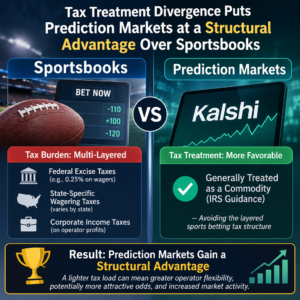
 The rapid expansion of sports event contracts on platforms such as Kalshi has exposed a significant gap in how federal and state tax frameworks treat prediction market activity compared with traditional sports betting. While licensed sportsbooks face a layered tax structure – federal excise taxes, state-specific wagering taxes, and corporate income taxes – prediction market operators regulated by the Commodity Futures Trading Commission (CFTC) have, to date, largely operated outside these obligations. That distinction is now drawing scrutiny from tax policy analysts, state officials, and lawmakers.
The Federal Excise Tax Framework
Under Section 4401 of the Internal Revenue Code, a federal excise tax has been levied on wagers since the 1950s. The rate is 0.25 percent of the amount wagered for bets authorized under state law, and 2 percent for wagers that are not so authorized. Licensed sportsbooks remit this tax on their handle as a routine cost of doing business.
Prediction market operators have generally not remitted the wagering excise tax, operating under the position that their event contracts are derivatives regulated by the CFTC rather than wagers under federal tax law. However, a recent analysis published by the Tax Law Center in Tax Notes examined whether sports event contracts on prediction markets should be treated as gambling for federal tax purposes. The analysis concluded that these contracts are subject to the federal excise tax on wagers and called on the Internal Revenue Service to provide guidance on the question.
The stakes are considerable. If the IRS were to treat prediction market contracts as unauthorized wagers, the applicable 2 percent rate could apply – a rate eight times higher than the standard excise tax borne by state-licensed sportsbooks. Analysts have noted that market makers, who execute high volumes of transactions, could face substantial exposure under such an interpretation.
The State-Level Gap
The divergence is even more pronounced at the state level. Legalized sportsbooks operate within frameworks that typically combine tax rates applied to gross gaming revenue with licensing fees, and in many jurisdictions those rates are substantial. Operators such as DraftKings also pay corporate income taxes in the states where they are licensed.
By contrast, because Kalshi is regulated federally as a designated contract market, it does not generally obtain state gambling licenses and does not remit state wagering taxes. Academic and policy analyses, including a thought leadership piece from North Carolina State University’s Poole College of Management, have characterized this as a significant tax gap, noting that prediction market providers remit far less to state coffers than sportsbooks generating comparable betting volume. States have responded with litigation and cease-and-desist actions, arguing that sports event contracts constitute gambling under state law regardless of their federal derivatives classification.
Policy Responses Under Consideration
The tax asymmetry has prompted proposals at both the federal and state levels. The Bipartisan Policy Center has examined the tax uncertainties surrounding prediction markets and has discussed a potential 5 percent federal excise tax on sports bets as a means of bolstering federal revenue while addressing the social costs associated with gambling expansion.
State legislatures have also begun acting. Some jurisdictions have moved to impose tax rates on prediction market activity identical to those applied to online sports betting, even while expressly disclaiming any intent to legalize prediction market activity – a signal of legislative intent to close the revenue gap through tax policy rather than licensing.
Additionally, the question of whether prediction market operators owe state taxes is expected to reach the U.S. Supreme Court, as litigation over whether sports prediction markets are subject to state gambling laws works its way through the judicial system. The outcome could determine the long-term tax liability of operators such as Kalshi.
Counterarguments and Industry Position
The industry maintains that the tax disparity reflects a legitimate regulatory distinction rather than an unintended loophole. Event contracts traded on CFTC-regulated exchanges are financial derivatives, and participants treat gains and losses under securities-style tax conventions rather than gambling provisions. Industry participants have also noted that consumer-level tax treatment remains unsettled, with questions persisting over whether profits from event contracts constitute gambling income, ordinary income, or something else entirely.
Supporters of the current framework argue that imposing wagering excise taxes on regulated derivatives markets would blur a longstanding boundary between financial regulation and gambling regulation, and could set precedents affecting other derivatives products.