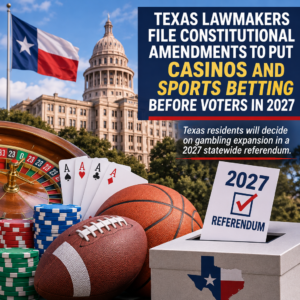
 A renewed effort to legalize commercial casino gaming and sports wagering in Texas has formally begun, with state lawmakers filing companion constitutional amendments ahead of the 2027 legislative session. The proposals would allow Texas residents – not legislators – to render the final verdict on gambling expansion through a statewide referendum scheduled for November 2, 2027.
The Proposals
Republican Representative Charlie Geren of Fort Worth filed House Joint Resolution 52, while Democratic Senator Carol Alvarado of Houston filed a near-identical Senate resolution. Both measures were submitted on the first day of pre-filing for the 90th Texas Legislature, which convenes in January 2027.
The resolutions share several core provisions:
-
A maximum of 10 licensed casino facilities statewide, with initial license terms of at least 40 years. Under the framework, casinos would be permitted in large metropolitan areas, including Dallas-Fort Worth, Houston, San Antonio, and Austin.
-
A tax rate capped at 15 percent on both casino gaming revenue and sports wagering revenue.
-
Creation of a Texas Gaming Commission, a dedicated regulatory body charged with overseeing casino gaming and sports betting.
-
Requirements for tribal gaming compacts, addressing the relationship between future commercial operations and the federally recognized tribes already operating limited gaming facilities in the state.
Because amending the Texas Constitution requires approval by two-thirds of both legislative chambers, the measures must secure substantial bipartisan support before reaching the ballot.
Political Context and Recent History
The pre-filing follows several unsuccessful attempts. In 2023, a Geren-sponsored sports betting resolution passed the Texas House but did not receive a Senate vote. In 2025, Alvarado’s Senate Joint Resolution 16 – which proposed up to seven destination resort casinos – similarly failed to advance in the Senate.
Lieutenant Governor Dan Patrick, who presides over the Senate and has expressed longstanding opposition to gambling expansion, remains a significant obstacle. Notably, during the 2026 interim, Patrick directed state senators to explore ways to restrict online prediction markets, which he characterized as gambling loopholes.
However, the political landscape may be shifting. The 2026 midterm elections have prompted observers to describe a legislatively referred ballot question on casinos and online sports betting as a more realistic possibility than in previous sessions. Governor Greg Abbott has previously indicated openness to discussing the matter, though he has not committed to a specific position.