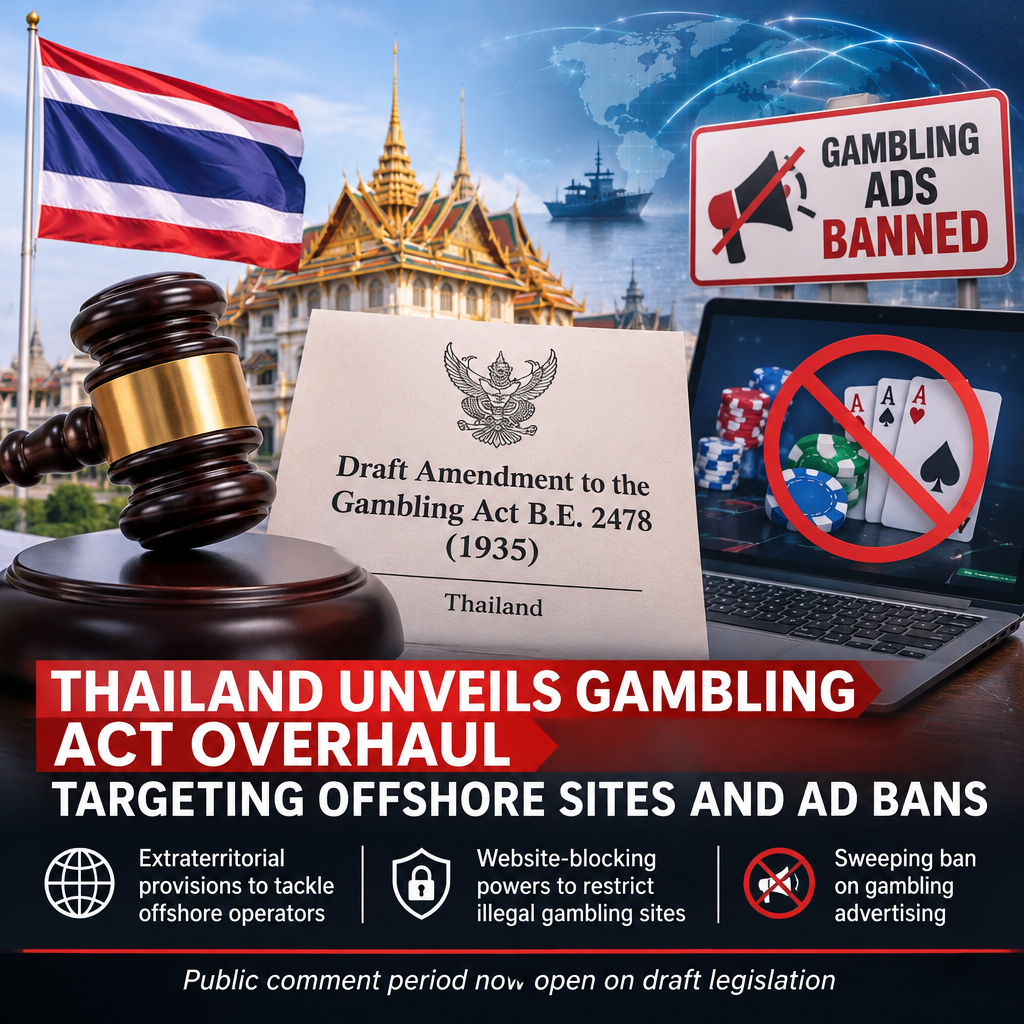
 Proposed legislation would modernise the country’s 1935 Gambling Act with extraterritorial provisions, website-blocking powers and a sweeping prohibition on gambling advertising.
Thailand’s Department of Provincial Administration has opened a public comment period on a draft overhaul of the country’s Gambling Act, introducing for the first time a comprehensive framework for regulating online gambling while significantly tightening penalties for offshore operators. The draft, published on 9 November, marks the most substantial revision to the Gambling Act B.E. 2478 (1935) since its enactment more than 90 years ago.
Key Provisions of the Draft
The proposed legislation adopts a technology-neutral definition of gambling, a departure from the current act, which predates the digital era and contains no specific provisions addressing online activity. This revision is intended to ensure that emerging gambling formats fall within the scope of regulation regardless of the platform or technology used.
Several measures stand out for operators and service providers with exposure to the Thai market:
-
Extraterritorial reach: The draft extends its application to offshore operators targeting Thai users, closing a long-standing enforcement gap that has allowed overseas platforms to serve the market with limited legal consequence.
-
Website blocking: Regulators would gain explicit authority to order the blocking of illegal gambling websites.
-
Intermediary obligations: Payment providers and other intermediaries would be assigned duties to restrict transactions connected to unauthorised gambling.
-
Advertising prohibition: The draft bans advertising, publicising, soliciting, recommending, or sponsoring gambling – directly or indirectly – through any medium. This is a significant expansion of Section 12 of the current act, which already prohibits the advertising of unauthorised gambling but is widely regarded as outdated in scope.
Penalties
The proposed penalty structure is substantially harsher than the existing regime. Commercial and online gambling offences carry prison sentences of up to 10 years and fines of up to THB5 million, or a multiple of the amount involved in the offence. Individuals participating in illegal gambling face fines of up to THB20,000. By comparison, penalties under the 1935 act range from three months to three years of imprisonment for organising or advertising offences.
The overhaul reflects growing concern over the scale of unregulated online gambling. Estimates cited in government and industry discussions suggest that more than THB150 billion (approximately USD4.8 billion) flows out of Thailand annually to overseas gambling platforms. Thai authorities have intensified enforcement in recent years, including nationwide police operations targeting gambling networks and coordinated website-blocking efforts led by the Ministry of Digital Economy and Society.
The draft arrives amid broader uncertainty over Thai gambling policy. The separate Entertainment Complex Bill, which would have permitted integrated resorts with casinos, was withdrawn by the Cabinet in July 2025 following the suspension of the Prime Minister, and a Senate committee subsequently rejected the legislation. Observers have suggested the casino bill could return in 2026, but its prospects remain unresolved. The current Gambling Act revision proceeds on a distinct track focused on enforcement rather than liberalisation.
For stakeholders, the dual-track approach signals that the government is prioritising control of illegal online gambling – a politically less contentious objective – while the question of licensed land-based gaming remains deferred.