



UK Financial Regulators Consider Easing Ban on Retail Prediction Markets



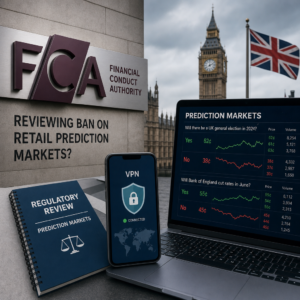 The UK Financial Conduct Authority (FCA) has initiated preliminary discussions with trading platforms to evaluate relaxing its long-standing prohibition on retail prediction markets. The regulatory re-examination comes as an increasing number of British retail consumers access foreign event-contract platforms via virtual private networks (VPNs).
Regulatory Background and Existing Bans
Under the UK’s current legal framework, event contracts that pay out on a binary outcome – such as whether a financial index, macroeconomic statistic, or specific event occurs – are categorized as binary options. In April 2019, the FCA implemented a permanent ban prohibiting firms from selling, marketing, or distributing retail binary options due to concerns over significant consumer losses and the high-risk nature of all-or-nothing payouts.
At the time the restriction was enacted, Christopher Woolard, then executive director of strategy and competition at the FCA, stated that “binary options are gambling products dressed up as financial instruments”. This rule has effectively blocked major US-style prediction market platforms, such as Kalshi and Polymarket, from legally onboarding UK retail investors for financial event contracts.
Drivers of the Policy Reconsideration
The rapid expansion of the global prediction market sector has prompted UK authorities to reassess the efficacy of the 2019 restriction. Industry representatives have presented evidence to regulators showing that British consumers routinely circumvent geographic restrictions using technology, leaving their trades outside the jurisdiction of UK financial oversight.
Proponents of regulatory reform argue that maintaining an absolute ban does not eliminate demand but instead deprives market participants of statutory protections. Emphasizing the challenge faced by policymakers, a city source noted in press reports that “it’s like most prohibitions – they are largely ineffective. The concerning thing is that regulators who have an obligation to prevent consumer harm are by their actions effectively driving consumers to operators with no regulatory standards at all”.
Regulatory Overlap and Market Structure
A key challenge in establishing a legal framework for prediction markets in the UK is navigating the division of regulatory oversight between financial and gambling authorities:
-
Financial Conduct Authority (FCA): Exercises jurisdiction over event contracts tied to financial indices, economic statistics, and specific commercial events. Operating these products requires lifting or amending the retail binary options ban.
-
UK Gambling Commission (UKGC): Oversees contracts referencing non-financial outcomes, such as sports and political elections. The UKGC clarified that commercial prediction markets offering wagers on non-financial events meet the legal definition of gambling, requiring operators to hold a betting intermediary license similar to traditional betting exchanges.
Consequently, a platform intending to offer a comprehensive range of political, economic, and financial event contracts in the UK would need to satisfy both financial conduct rules and gambling compliance standards.
Supporters of a modernized framework argue that bringing prediction markets into the regulated perimeter would enable the FCA to enforce standardized risk warnings, anti-money laundering controls, and capital requirements. Conversely, consumer advocacy groups maintain caution, noting that binary event contracts carry elevated financial risks for retail participants due to their derivative structure.
While discussions remain exploratory and no formal policy changes have been enacted, the FCA’s engagement with trading platforms indicates a potential shift in how the UK approaches emerging retail financial products. Any prospective regulatory adjustment will require coordination between the FCA and the UK Gambling Commission to establish consistent standards across financial derivatives and wagering activities.