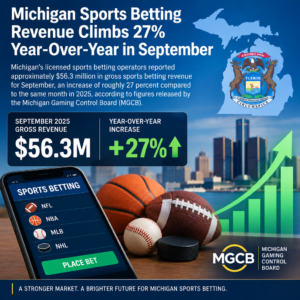
 Michigan’s licensed sports betting operators reported approximately $56.3 million in gross sports betting revenue for September, an increase of roughly 27 percent compared to the same month in 2025, according to figures released by the Michigan Gaming Control Board (MGCB). The result marks a notable rebound for a market that had experienced year-over-year declines in prior periods and underscores the state’s position as one of the more consistent performers in the legal U.S. sports wagering landscape.
Online Drives the Majority of Revenue
As in previous months, internet sports betting accounted for nearly all of the state’s gross receipts. The MGCB reported that online sports betting operators generated $55.5 million in gross revenue for the month, with retail sportsbooks at Detroit’s three commercial casinos contributing a comparatively small share. The combined figure of $355.7 million in internet gaming and online sports betting gross receipts for September placed the market among its stronger monthly showings of the year.
The month-over-year context also matters for industry observers. September’s performance followed a softer August, in which combined online casino and sports betting gross receipts reached $337.6 million, with online sports betting adjusted gross receipts of $24.2 million. The seasonal return of football typically lifts wagering volumes, and the September results are consistent with that pattern.
Michigan’s sports betting framework continues to operate under the state’s established regulatory structure. Online sports betting revenue is taxed at a rate of 8.4 percent, applied to adjusted gross receipts after deductions for promotional activity such as free bets and bonuses. Because the state permits promotional deductions, Michigan has historically recorded one of the lower effective tax rates for operators among U.S. jurisdictions – a factor that has drawn ongoing attention from state policymakers.
The Michigan House Fiscal Agency has previously highlighted the fiscal implications of those deductions, estimating that free play deductions have cost the state a meaningful amount of potential sports betting tax revenue since legalization. Any sustained growth in gross receipts, such as that recorded in September, therefore carries relevance not only for operators but also for state and municipal budget discussions.
Detroit’s commercial casinos reported $12.39 million in total retail sports betting handle for September, with retail sports betting revenue rising modestly. While in-person wagering remains a small fraction of the overall market – online channels routinely account for well over 90 percent of gross receipts – the retail segment continues to provide incremental revenue for the city’s three licensed casinos.