


Nebraska Voters to Decide on Online Sports Betting In November



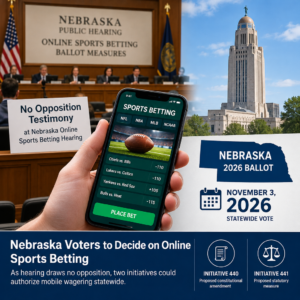 A public hearing concerning Nebraska’s proposed online sports betting ballot measures concluded without a single opponent offering testimony, a notable development as the state prepares for a November 3, 2026 vote that could authorize mobile wagering statewide.
Nebraska voters will consider two related initiatives in the 2026 general election. Initiative 440 is a proposed constitutional amendment that would permit the Nebraska Legislature to enact laws authorizing online sports wagering, provided the individual placing the wager is physically located within the state at the time of the bet. Initiative 441 would then allow and regulate online sports betting, granting the Nebraska Racing and Gaming Commission authority to adopt the rules governing operators and tying the activity to licensed Nebraska racetracks.
Both measures originated with Tax Relief Nebraska, a ballot question committee that began circulating petitions in February and submitted approximately 350,000 signatures in July. The signatures were subsequently verified, securing the initiatives’ placement on the November ballot.
Proponents contend the measures would generate substantial new revenue for the state, with campaign materials directing attention toward property tax relief – an issue of persistent political salience in Nebraska. Supporters have also emphasized that the initiatives concern online sports wagering specifically, rather than expanding full-scale casino gaming onto mobile devices.
A Hearing Without Opposition
The recent public hearing, held in Congressional District 1, drew attention for what did not occur: no opponents appeared to testify against the measures during the proceeding. The absence of in-person opposition stands in contrast to the broader campaign landscape, where organized resistance has taken shape in recent months.
Although the hearing itself attracted no opposing voices, resistance to the initiatives exists and has grown more visible. State Auditor Mike Foley has emerged as a prominent critic, arguing that projected tax revenues from online sports betting would deliver only modest property tax relief – approximately $12 million annually by his assessment – and that the promised benefit depends on Nebraskans losing more money in wagers than they would receive in return. Foley has characterized the property tax relief narrative as a false promise.
A group called Save Nebraska Sports launched a campaign against the measures in September, joined by additional state officials. Critics, including the Nebraska Family Alliance, have also argued that the initiatives were written by and for out-of-state gambling companies, and have questioned campaign revenue projections that differ significantly from opposition estimates.