


Utah Attorney General Files Lawsuit Against Kalshi, Seeking Up to $60 Million



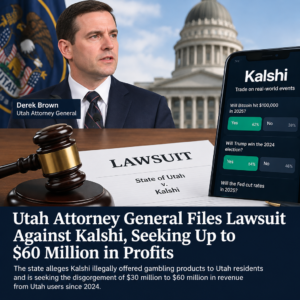 Utah Attorney General Derek Brown has announced a civil lawsuit against prediction market operator Kalshi, alleging the platform illegally offered gambling products to Utah residents. The state is seeking the disgorgement of an estimated $30 million to $60 million in revenue generated from Utah users since 2024, with the final amount to be determined through litigation. The action marks a significant escalation in state-level enforcement against federally regulated prediction markets and carries implications for operators across the sector.
Key Elements of the Lawsuit
According to the Utah Attorney General’s Office, the lawsuit characterizes Kalshi’s sports-related event contracts as functionally identical to wagers placed with traditional online sportsbooks. The state contends these contracts are “indistinguishable” from sportsbook bets and therefore fall squarely within Utah’s constitutional prohibition on gambling, one of the strictest in the United States.
Beyond monetary relief, the state is asking the court to order Kalshi to cease offering online betting tied to sports, elections, politics, and cultural events to Utah residents. The complaint describes what it calls a “brazen pattern” of violations, noting that the platform continued accepting bets from Utah users even after adverse federal court rulings.
The lawsuit builds on an earlier legal victory for the state. In August, U.S. District Judge Robert J. Shelby granted Utah summary judgment, rejecting Kalshi’s argument that its status as a federally registered exchange shielded its sports event contracts from state gambling laws. Kalshi’s motion for a preliminary injunction was denied in the same ruling.
The Utah decision aligns with a broader judicial trend. In September, a federal appeals court ruled that Kalshi’s sports-event contracts are subject to Tennessee’s sports wagering laws, reversing a lower court determination. Together, these rulings suggest that federal regulatory status may not preclude state enforcement – a development with considerable significance for prediction market operators marketing event contracts nationally.
Industry and Regulatory Landscape
The action against Kalshi does not occur in isolation. Utah’s attorney general previously led a bipartisan coalition of roughly 50 attorneys general urging the U.S. Department of Justice to intensify enforcement against illicit online gambling, including offshore operators and unregulated prediction markets. Separately, class action lawsuits have accumulated against sweepstakes casino operators in Utah, where plaintiffs argue that dual-currency models violate the state’s explicit ban on online gambling.
Attorney General Brown framed the enforcement action in consumer-protection terms. “These companies, they’re not your friends,” Brown said, characterizing the platforms as exposing residents to unregulated gambling without state oversight or accountability.
For its part, the prediction market industry has consistently maintained that event contracts traded on federally registered exchanges are commodities under the Commodity Exchange Act and fall outside state gambling statutes. Kalshi has not publicly indicated whether it will contest the Utah suit, appeal prior rulings, or seek settlement.