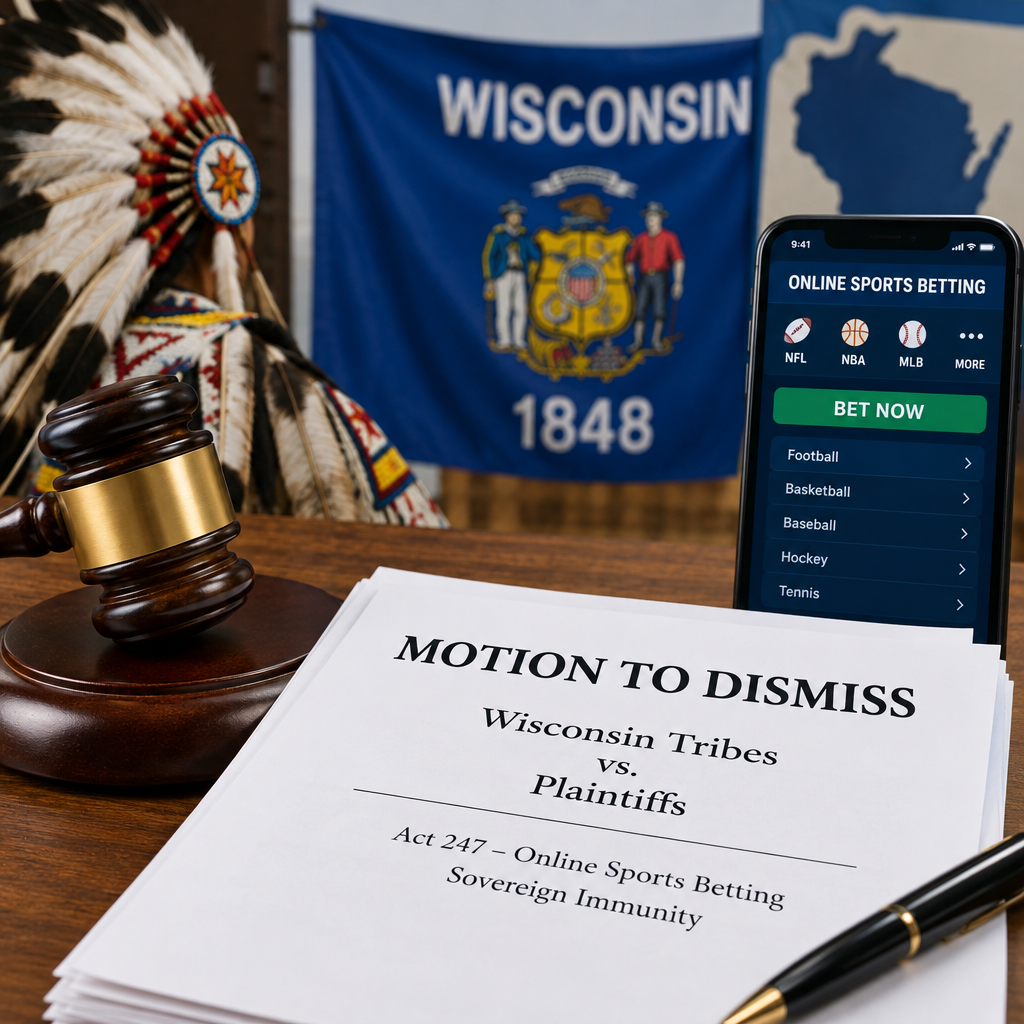
 Eight of Wisconsin’s Native American tribes have formally asked a state court to dismiss a lawsuit challenging the legality of Act 247, the statute that authorizes statewide online sports betting through tribal gaming operations. The motion, filed on October 14, argues that the tribes are protected by sovereign immunity and that the plaintiffs’ constitutional claims mischaracterize the legal foundation of tribal gaming in the state.
Background: Act 247 and the Legal Challenge
Act 247 was signed into law by Governor Tony Evers in April 2026, following a bipartisan legislative effort to expand sports wagering beyond in-person facilities. The law permits online and mobile sports betting across Wisconsin, provided that the servers or devices used to place bets are physically located on tribal lands. The structure mirrors the “hub-and-spoke” model adopted in other states, in which wagers placed anywhere in the state are routed through servers on tribal property.
The measure was widely supported by tribal leaders, who viewed it as an extension of the exclusive gaming compacts that Wisconsin’s eleven federally recognized tribes hold with the state. As of October 2026, no statewide online sportsbooks have yet launched.
The challenge originated with the Brown County Taxpayers Association, represented by the Wisconsin Institute for Law & Liberty (WILL), a conservative public interest law firm. The suit was filed in Waukesha County in August 2026 against Governor Evers and other state officials. The plaintiffs argue that Act 247 violates the Wisconsin Constitution, including a 1993 amendment that restricts the Legislature’s ability to authorize certain forms of gambling expansion. They further contend that the law grants an exclusive statewide sports betting privilege based on race through tribal membership, in violation of equal protection guarantees.
The Tribes’ Motion to Dismiss
In their response filed October 14, attorneys for the eight tribes requested that the case be dismissed with prejudice. The filing advances two central arguments: first, that tribal sovereignty and immunity shield the tribes from claims of this nature, and second, that the plaintiffs’ race-based framing of the dispute is legally flawed.
According to the tribes’ position, the relationship between tribal nations and state and federal governments is rooted in treaties and federal law, not in racial classification. Tribal gaming rights derive from their status as sovereign nations, a distinction long recognized in federal statutes such as the Indian Gaming Regulatory Act.
The tribes are not the only parties defending the law. In September, the state filed its own response in Waukesha County, arguing among other points that the taxpayer group lacks standing to bring the challenge. Assistant Attorney General Colin Roth represented the state in that filing.
The litigation carries significant implications for the state’s gaming industry. Act 247 was designed to bring legal, regulated online sports betting to Wisconsin through the existing tribal framework, rather than through a commercial sportsbook model. A ruling against the law could halt implementation before any statewide mobile wagering platform goes live, while a ruling in favor of the state and tribes would clear the path for launch.
The dispute also unfolds against a broader backdrop of gaming-related legal activity in Wisconsin. Separately, the state has pursued action against several online prediction market platforms, alleging that they facilitate unlawful sports betting, and the Ho-Chunk Nation has pursued its own litigation against such operators.